After the AI Selloff: Testing Whether Stress Is Still Contained
An update of the 18 October advisory. The November break demands a fresh test of that contained-stress case. Broader damage and sharper AI financing strains weaken the benign interpretation, without establishing an imminent crash.
November 8, 2026
Update of the 18 October 2026 PAM Market Advisory: Contained Stress, Not an Imminent Crash
The November break demands a fresh test of that contained-stress case. Broader damage and sharper AI financing strains weaken the benign interpretation, without establishing an imminent crash.
Summary
- This note updates the 18 October contained-stress advisory. The 5 November selloff broadened beyond AI; spillover now deserves more weight.
- CoreWeave bond yields above 16% and Oracle CDS near 298 basis points show issuer-level financing stress, not proof of a systemic credit crisis.
- Friday’s partial equity bounce and VIX decline did not restore the earlier benign regime; credit ETFs did not confirm the stabilization.
- Oil and a hawkish Fed complicate the adjustment. Mean-reversion remains conditional, with no current TailDex reading available to validate October’s protection-market argument.
Update note. This article updates the PAM Market Advisory published on 18 October 2026, Contained Stress, Not an Imminent Crash. The original four-path framework is unchanged. What is being revised is the assessment. The mid-October conclusion of a still-benign regime — with selective AI stress and mean-reversion as the base case — is retested here against the 5–6 November 2026 tape, the last two sessions available as of Sunday, 8 November.
The 18 October advisory described selective AI stress, not an imminent broad-market crash. Its base case was a still-benign regime with a credible path toward mean-reversion: concentrated equity losses, more expensive crash insurance, and limited evidence of broader transmission.
The evidence has deteriorated. Containment remains a possible outcome, but it is no longer an established condition. Broader spillover deserves more weight, while a return to the earlier benign regime requires confirmation. That is a change in the assessment, not a crash call.
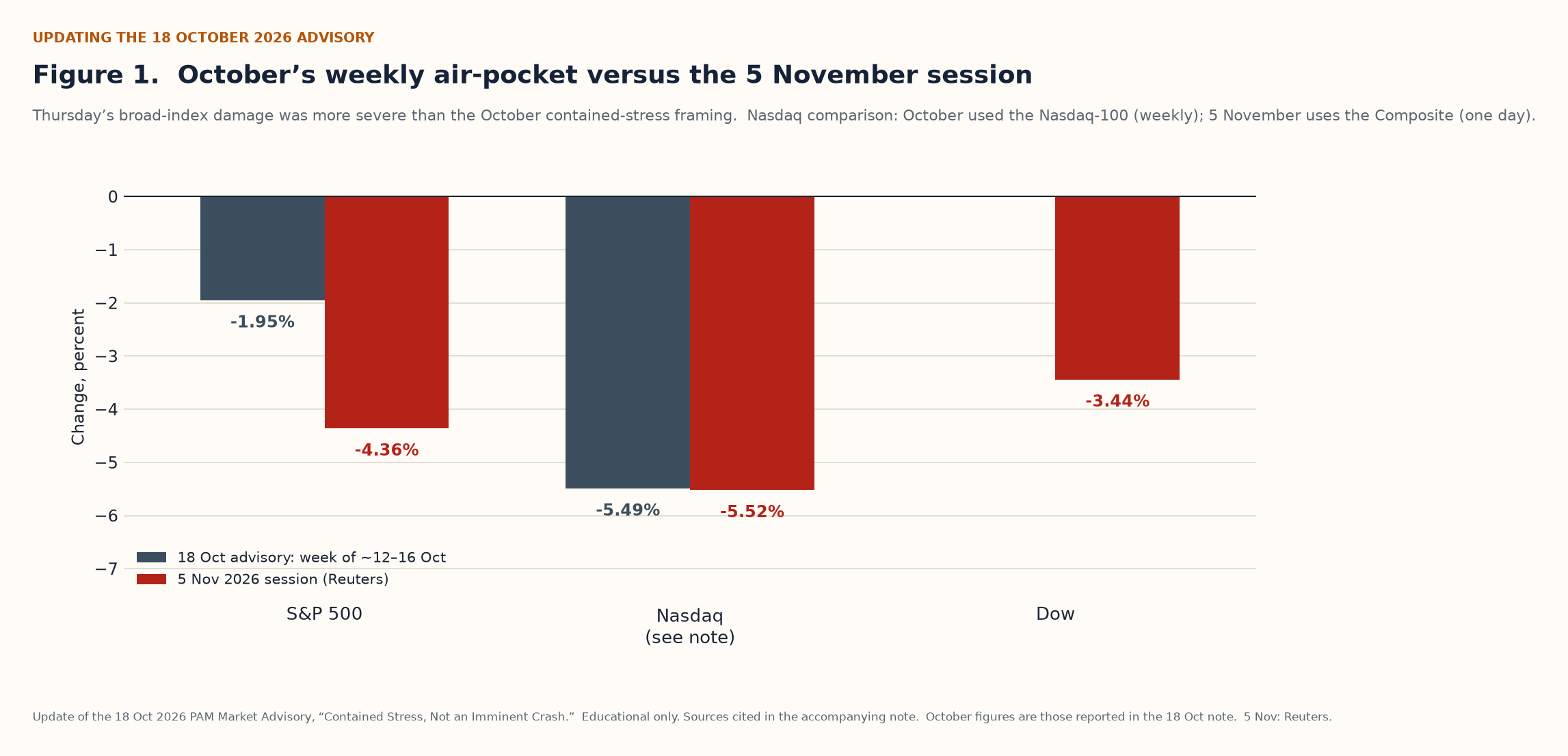
Figure 1 places October’s weekly figures, as that earlier note reported them, next to the 5 November session.
What actually moved
The October advisory reported a weekly S&P 500 decline of 1.95% and a Nasdaq-100 decline of 5.49%. Those are historical figures from that note, not current readings.
On Thursday, 5 November, the S&P 500 fell 4.36% to 7,353.73, while the Nasdaq Composite lost 5.52% to 24,315.00, according to Reuters. The Nasdaq closed more than 10% below its 6 October record, entering a correction. The Dow fell 3.44%. The October Nasdaq comparison uses the Nasdaq-100, not the Composite; the measures and time windows differ. Even with that qualification, Thursday’s broad-index damage was materially more severe than October’s contained-stress framing anticipated.
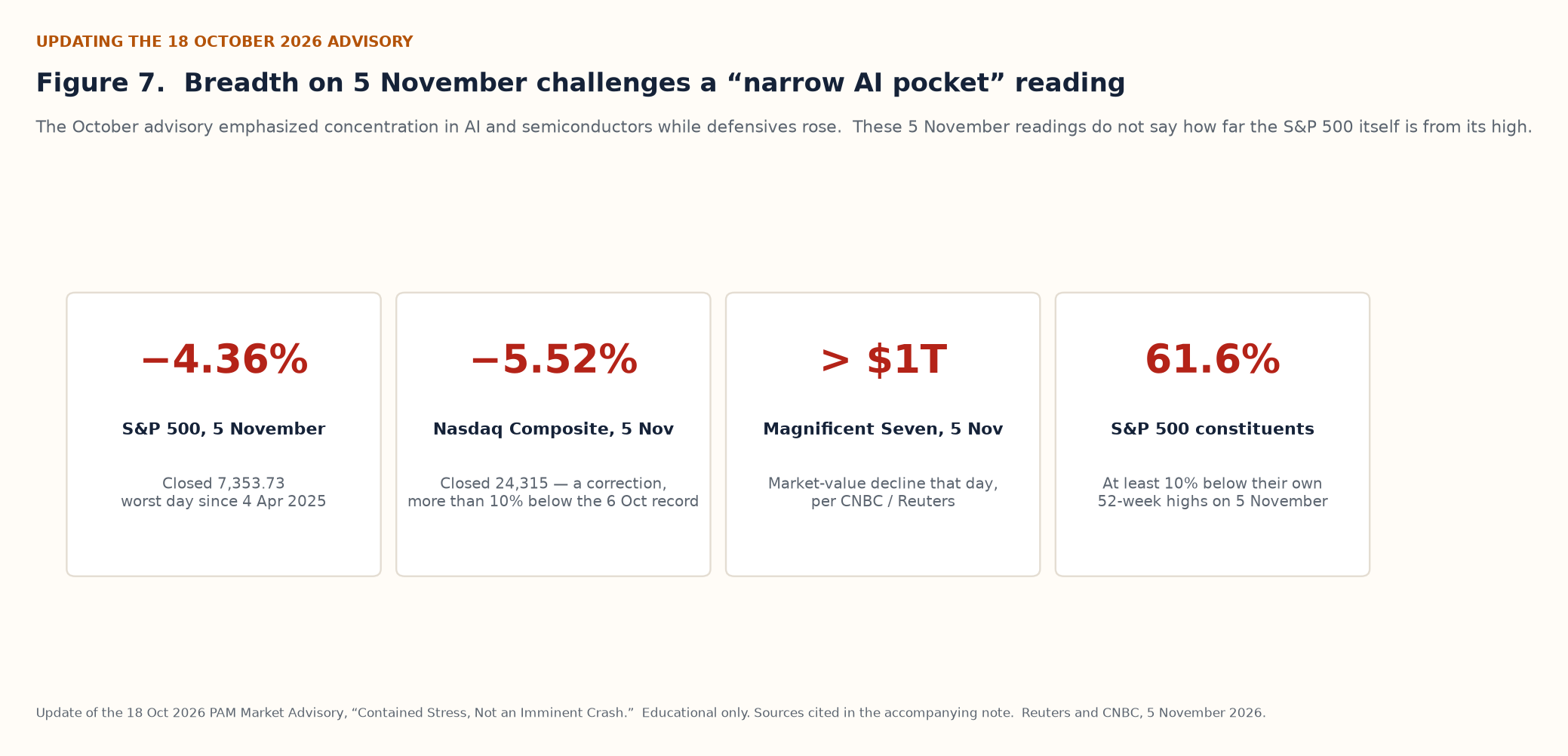
Concentration in technology remained conspicuous, but breadth also weakened. CNBC and Reuters reported that the Magnificent Seven lost more than $1 trillion on 5 November, while 61.6% of S&P 500 constituents were at least 10% below their respective 52-week highs. That breadth measure does not tell us how far the index itself is below its high. It does challenge the idea that only a narrow AI pocket is under pressure. Figure 7 summarizes those breadth readings.
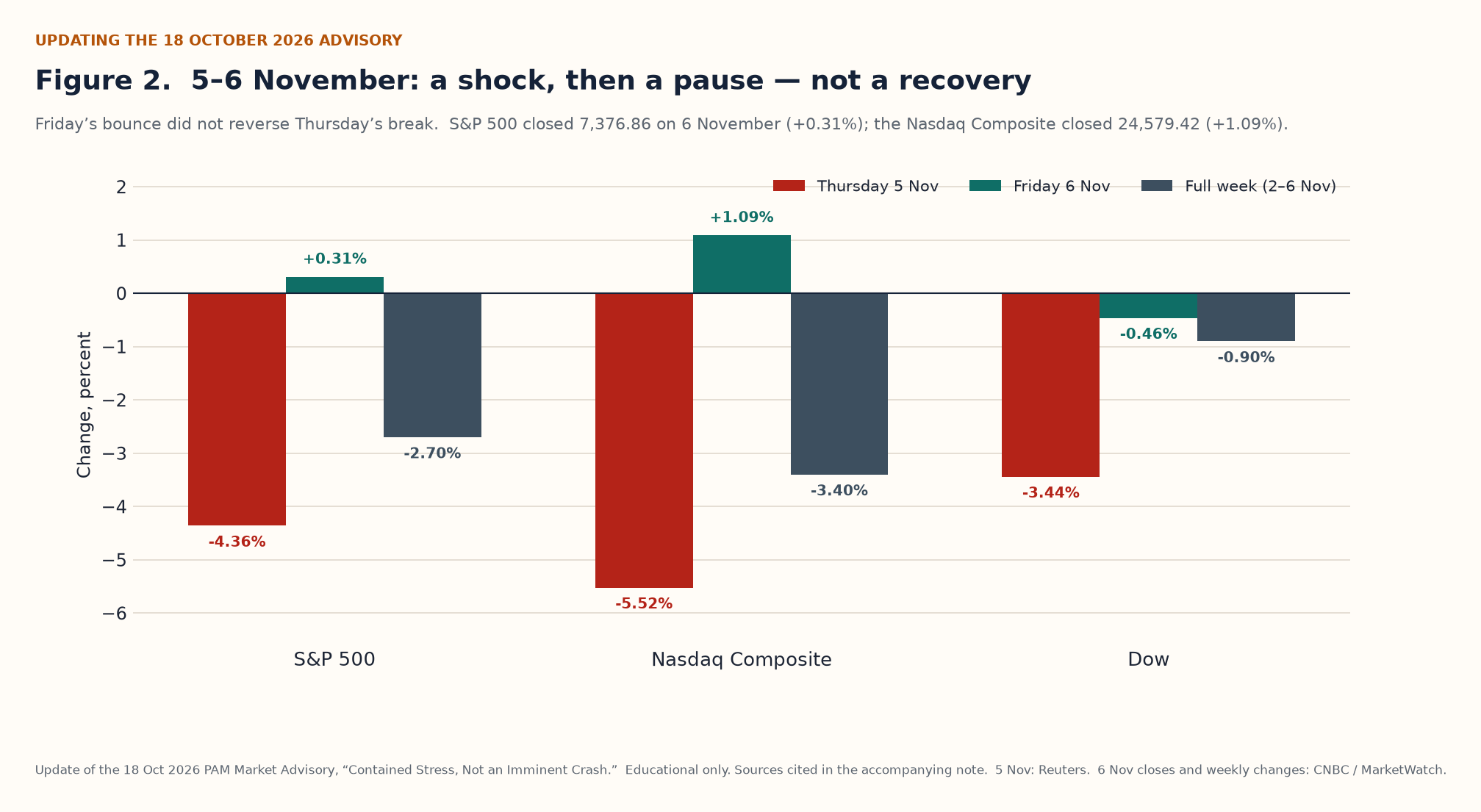
Friday, 6 November, offered stabilization, not recovery. The S&P 500 gained 0.31%, the Nasdaq Composite rose 1.09%, and the Dow fell 0.46%, according to CNBC and MarketWatch. MarketWatch reported that gains faded near the close. CNBC put the week’s losses at 2.7% for the S&P, 3.4% for the Nasdaq, and 0.9% for the Dow. Figure 2 shows the Thursday shock, the Friday pause, and the week together.
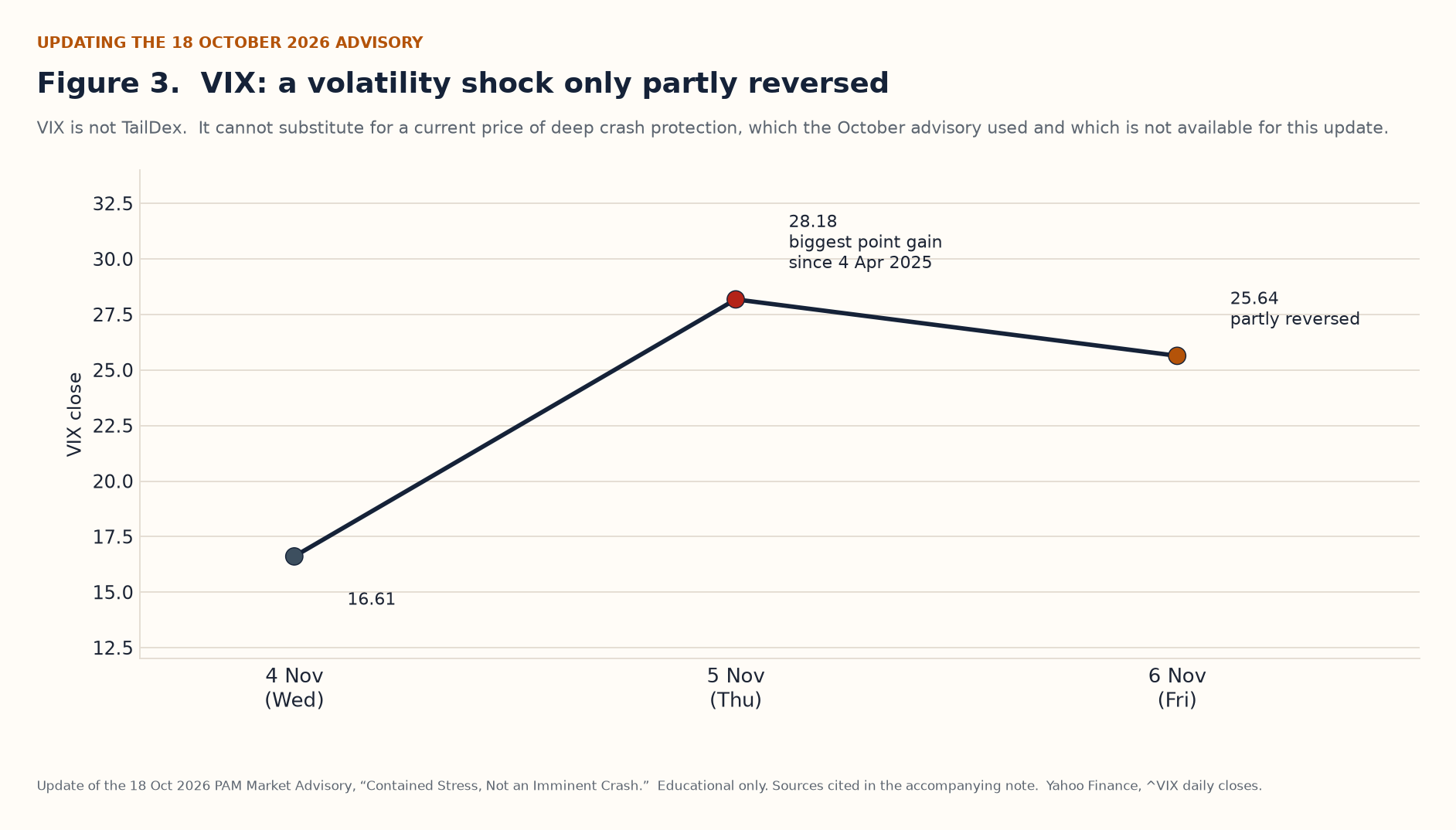
Yahoo’s VIX readings moved from 16.61 on 4 November to 28.18 on 5 November, then eased to 25.64 on 6 November. That is a volatility shock only partly reversed. VIX is not TailDex, and it cannot substitute for a current price of deep crash protection — the measure the October advisory used and which is not available for this update (Figure 3).
Primary drivers
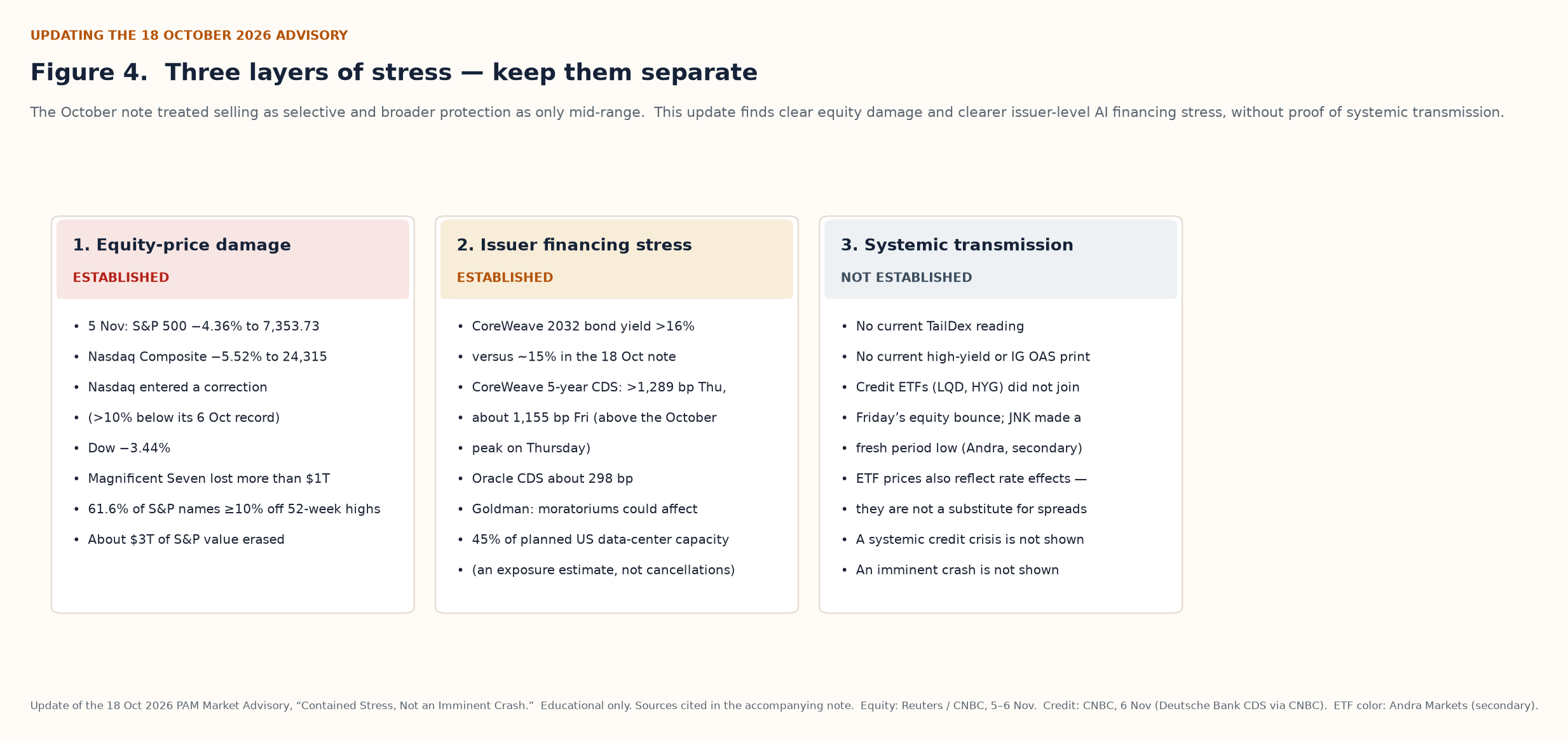
The distinction between equity damage, issuer financing stress, and systemic transmission is essential. Figure 4 keeps those three layers separate.
First, equity prices are repricing both AI expectations and broader macroeconomic risk.
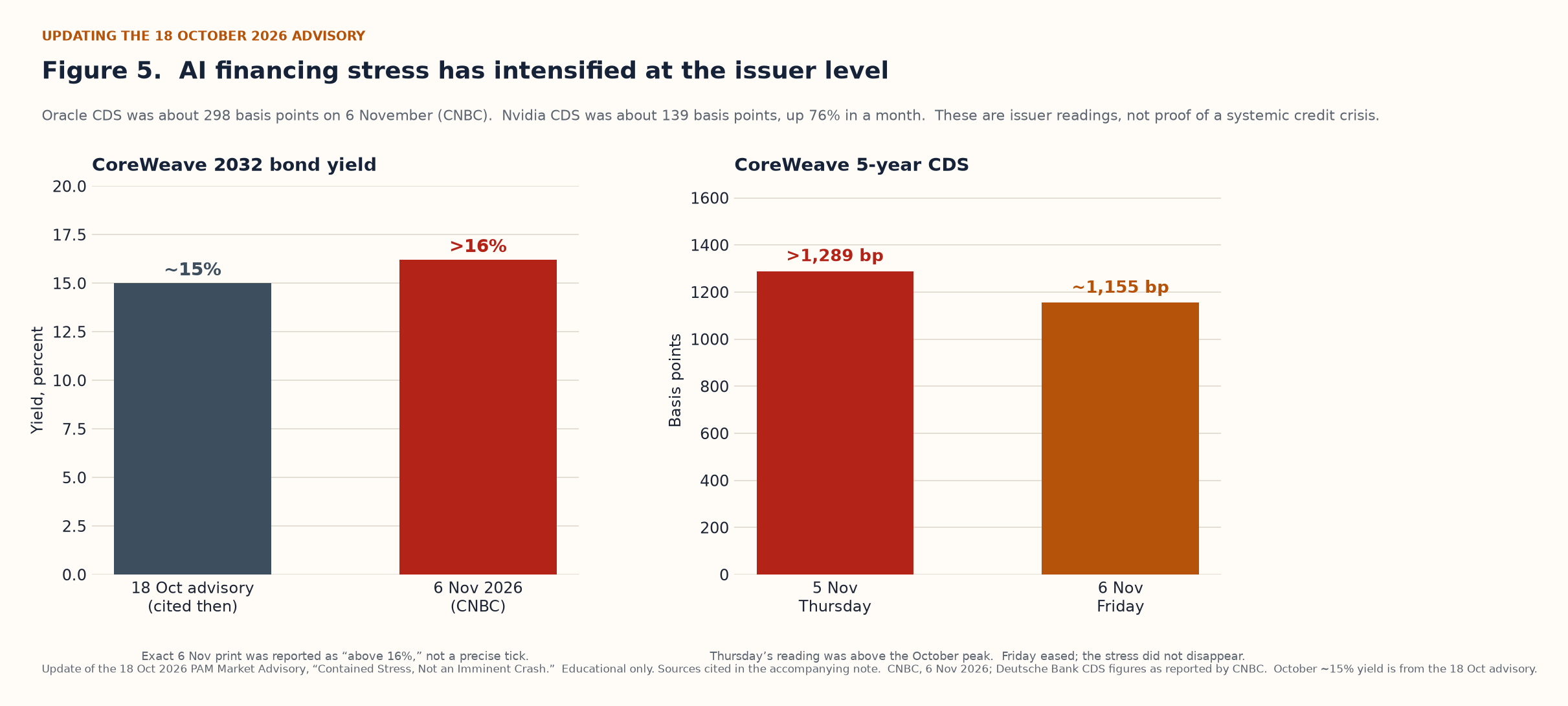
Second, financing pressure within the AI complex has intensified. CNBC’s 6 November reporting put the yield on CoreWeave’s 2032 bond above 16%, versus roughly 15% cited in the October advisory. Oracle CDS stood around 298 basis points. CoreWeave’s five-year CDS exceeded 1,289 basis points on Thursday before easing to about 1,155 on Friday, using Deutsche Bank figures reported by CNBC. Partial relief did not erase the stress. Figure 5 shows that issuer-level intensification.
CNBC also reported Goldman’s estimate that moratoriums could affect 45% of planned US data-center capacity. This is an estimate of exposure, not a statement that those projects have been cancelled. It nevertheless raises legitimate questions about the timing of capacity, revenues, and financing needs.
Third, systemic transmission is not established by the available evidence. Current broad high-yield and investment-grade option-adjusted spreads are unavailable for this assessment. So is a current TailDex reading. Andra Markets, a secondary source, reported that LQD and HYG fell on 6 November and JNK reached a fresh period low. Credit ETFs did not join Friday’s equity bounce, but their prices also reflect interest-rate effects; they are not a substitute for broad credit-spread measurements.
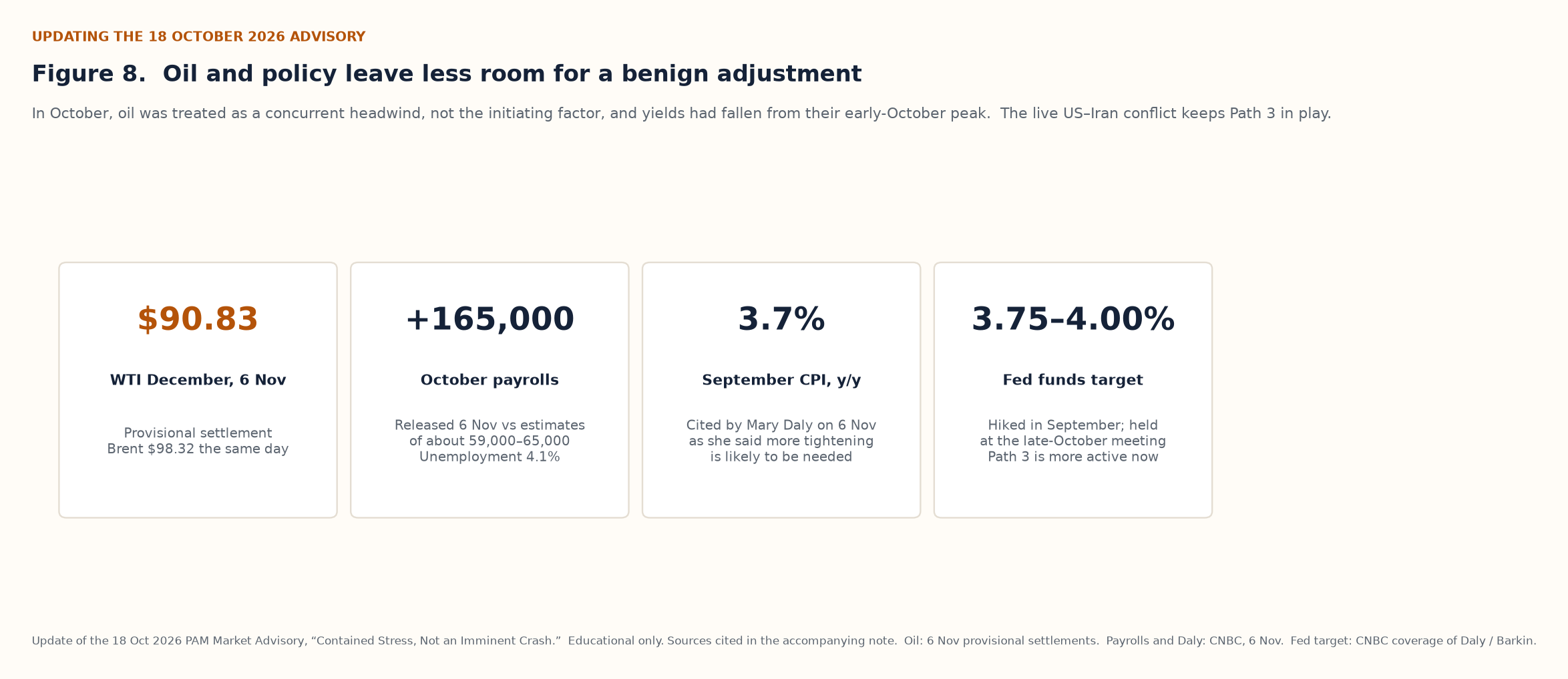
The macro backdrop offers less reassurance than an easing narrative would suggest. October payrolls, released on 6 November, rose 165,000 and unemployment fell to 4.1%, according to CNBC. The report does not support a simple weak-labor-market explanation. In her 6 November CNBC remarks, Mary Daly expected further tightening and cited September CPI inflation of 3.7%.
On 6 November, December WTI provisionally settled at $90.83 and Brent at $98.32. Reuters that day pointed to Federal Reserve concern about inflation stemming from the Middle East conflict. The live US–Iran conflict remains relevant. Oil is no longer merely a background complication. Figure 8 collects those constraints.
Four paths from here
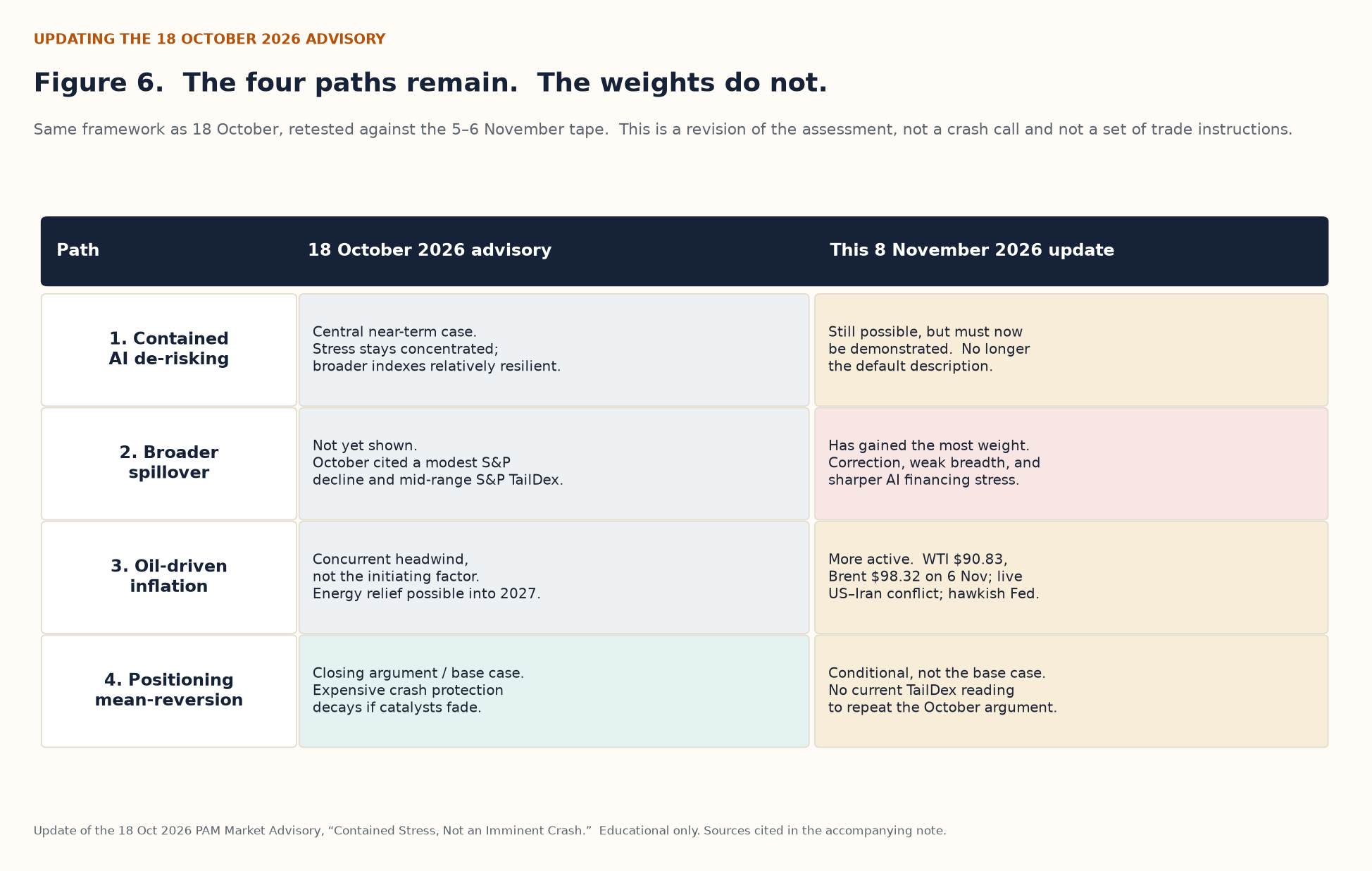
The four paths named on 18 October remain the working framework. Figure 6 shows how their weights have changed in this update.
1. Contained AI de-risking
This path remains coherent if pressure re-concentrates in AI, semiconductors, and data-center financing while the broader tape stabilizes. Issuer-level credit improvement would help distinguish an adjustment in project economics from a more persistent financing problem.
But Thursday’s breadth and Friday’s incomplete stabilization mean containment must now be demonstrated. A modest rebound in a damaged index is insufficient. The October central case survives as a conditional path, not as the default description of the market.
2. Broader spillover
This path has gained the most weight since October. The Nasdaq correction, extensive constituent drawdowns, large technology losses, and sharper financing stress collectively weaken the selective-repricing interpretation. Credit’s failure to confirm Friday’s equity bounce adds caution, subject to the measurement limitations already noted.
The next distinction is whether weakness continues to spread beyond the most exposed businesses and whether broad credit measures confirm it. Persistent equity breadth deterioration alongside wider financing stress would strengthen this path. Durable stabilization outside AI and improving issuer credit would weaken it. Neither a systemic credit crisis nor an imminent crash follows automatically from the evidence now available.
3. Oil-driven inflation pressure
This path is more active than it was in the October framework. Elevated crude, a live conflict, and a Fed still discussing additional tightening constrain the scope for a benign adjustment. September’s inflation reading and the stronger-than-expected October payroll gain do not provide an uncomplicated route to policy relief.
The next CPI print is the near-term inflation test. The relevant question is whether energy pressure persists and reinforces broader inflation, or fades enough to reduce the constraint. Geopolitical headlines can alter that balance quickly; neither sustained escalation nor rapid relief should be assumed.
4. Positioning-driven mean-reversion
A positioning reversal remains possible. Friday’s Nasdaq gain and lower VIX are consistent with some immediate pressure easing. They do not establish that the underlying financing and inflation concerns have passed.
The October argument leaned partly on the pricing of tail protection. Without a current TailDex reading, we cannot repeat its assessment of protection levels or conclude that an insurance overshoot is now reversing. Mean-reversion would gain credibility with sustained broader-market stabilization, improving AI credit, and less pressure from oil and policy expectations. It is conditional, not the closing base case.
Bottom line for experienced PAM investors
This update revises the 18 October conclusion; it does not invert it into a crash call. The evidence no longer supports carrying forward a benign regime and mean-reversion as the default. Broader spillover deserves greater attention, while contained AI de-risking remains possible if subsequent evidence supports it.
Equity damage is clear. Issuer-level AI financing stress is clear. Systemic transmission remains unproven. Keeping those layers separate avoids both complacency and an unsupported crash narrative.
The practical analytical task is to watch breadth, issuer financing, broad credit confirmation, volatility persistence, oil, and the next inflation reading. Friday provided a pause. It did not settle which path the market is taking.
Educational only.
Copyright Robert P. Balan (November 2026)