Why Trading the S&P 500 0DTE Plumbing Beats Trading The Price Level
Customer flow is the tap. GEX is the plumbing. The S&P 500 price is where the water has settled.
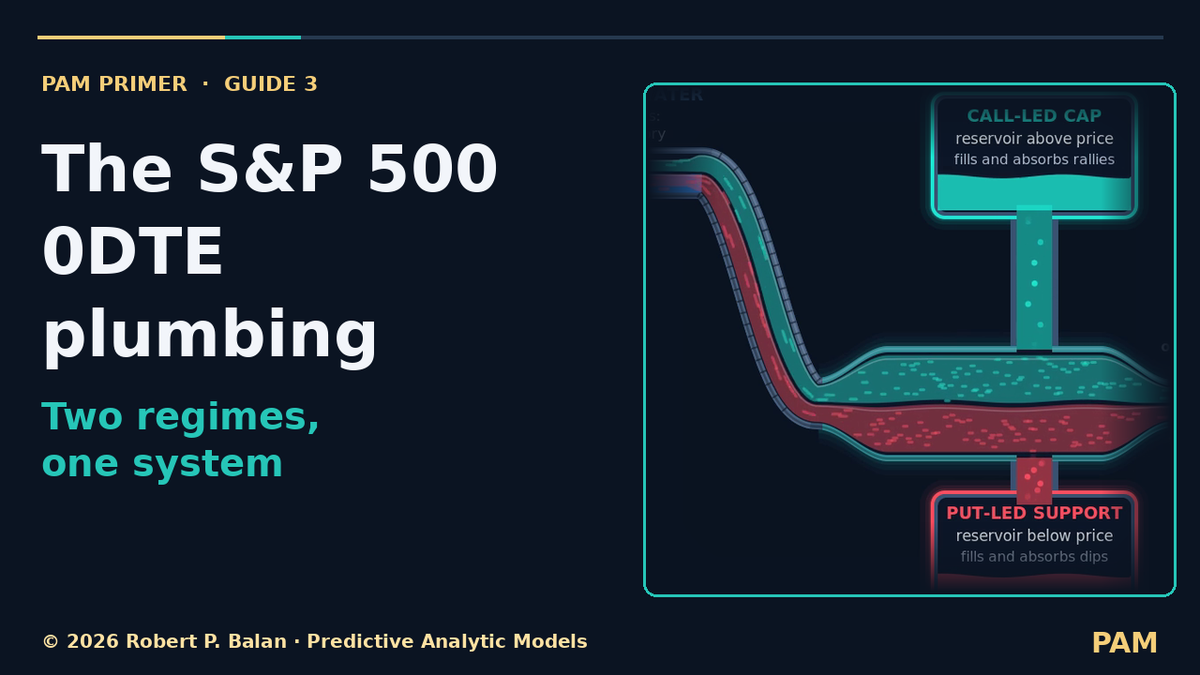
This is the full film. The three regime cuts follow in the essay, and sit with Guides 1 and 2 on the PAM primers playlist.
Most readings of the S&P 500 options book stop at one question: is GEX positive or negative? That question is only the first step. It names the state of the pipes. It does not tell you how the system is built, what the tap is doing now, or why the water sometimes pools and sometimes runs.
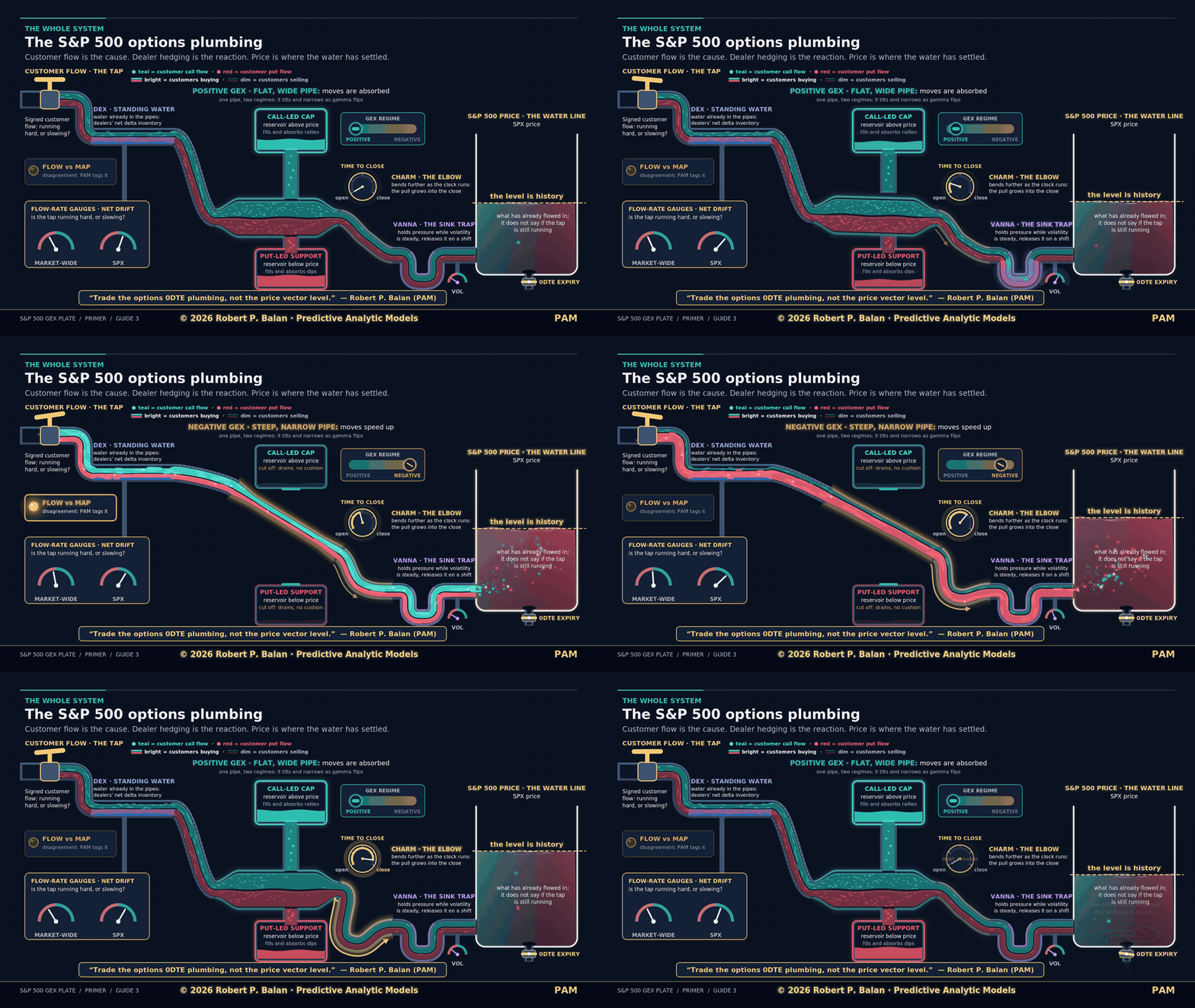
Predictive Analytic Models reads that book as plumbing. The S&P 500 price is the water line in the tub. It is history: the level the water has already reached. It cannot tell you whether the tap is still open. Two tubs can sit at exactly the same level, one filling fast and one about to drain. Customer flow is the tap, happening now. GEX is the plumbing between the tap and the tub, the pipework that decides whether the water pools, rushes or drains.
Customer flow is the cause. Dealer hedging is the reaction. The water line is only where that work has settled.
That is what makes this read different. A price-first view watches the water line and asks where it will go next. A plumbing read watches the tap and the pipes, and asks what kind of move the system is set up to absorb, or to speed up. The level will follow. It is not the cause.
Read the streams this way. Teal is customer calls, and red is customer puts. Bright means customers are buying, and dim means they are selling. The colour tells you which side of the book is active. The brightness tells you whether customers are adding or reducing.
GEX is the main pipe network, and it has two regimes. When gamma is positive, the pipe is flat and wide, and the reservoirs are connected. Dealers lean against the move: their hedging sells into rallies and buys into dips, so swings tend to get absorbed, and the water often drifts higher. When gamma is negative, the pipe tips steep and narrow, and the reservoirs are cut off. Dealers chase the move: their hedging buys as price rises and sells as it falls, so moves run faster, with a downside lean, and the water swings both ways. These are tendencies, not calls.
The fittings do the rest of the work.
Charm is the elbow. As the clock runs toward the close, an option's delta changes even if price does not move at all, so the dealers' hedge has to change too. The elbow steers the flow with time alone. On 0DTE options that bend sharpens into the last hour, and it often steers the flow to a pin, where the water settles.
Vanna is the sink trap. It holds pressure while volatility is steady, and it releases that pressure when volatility shifts. In the S&P 500, rallies tend to ease implied volatility and selloffs tend to lift it, so one move in the water line usually triggers both GEX and vanna hedging at once. Where the two share a sign, a hold tends to be sturdier, or a break harder. Where they are mixed, the level is less dependable.
The reservoirs are the cushions. In positive gamma they fill and absorb the swings. In negative gamma they are cut off, and there is no cushion.
The map is the pipework already in place, a record of where customers have already traded. The tap is the live flow, now. Live flow outranks residual gamma. When the two disagree — when the tap says calls, for example, but the map leans lower — the FLOW vs MAP light comes on, and PAM tags the disagreement. The tag does not pick a winner in advance. It says plainly that the map says one thing, the flow says another, and which one the day's read is leaning on.
At the close, the 0DTE expiry drain empties the book. The plumbing resets. Tomorrow the pipe can tilt the other way. The water line left behind is still history. The next session starts with a new tap and, often, a new shape of pipe.
The three films below walk that system in a fixed order: positive gamma first, then negative gamma, then both regimes in one composite. Atlas talks through the changes as they happen.
Positive gamma is the absorbing regime. Watch the pipe stay flat and wide. The reservoirs fill and take in the swings, even a burst of put buying. The water often drifts higher. Into the close, charm steers the flow to a pin, and the water settles. Then the 0DTE book expires, and the plumbing resets.
Negative gamma is the speeding regime. Watch the pipe tip steep and narrow, with the reservoirs already cut off, so there is no cushion. Moves run faster, with a downside lean, and they swing both ways. Vanna can burst when volatility jumps. When the tap says calls but the map leans lower, the FLOW vs MAP light comes on, and PAM tags the disagreement. Then the book expires, and tomorrow the pipe can tilt the other way.
The composite is the linchpin: one system, two regimes, the same plumbing flipping from one shape to the other and back. GEX turns negative, the pipe tips, and the reservoirs are cut off. The water line swings fast and leans lower. Vanna bursts. Then GEX flips back positive. The pipe lies flat again, and the swings calm down. Once the pipe is flat, charm steers the flow to a pin. Only after that flat stretch does the 0DTE book expire. The level is history, and the flow is what moves it.
Why read the plumbing, and not only the level? Because the water line cannot tell you whether the tap is still open. Because a quiet net number on the GEX plate can hide two large pipes pushing against each other. Because a burst at the tap can redraw a map that was true an hour ago. If you watch only the water line, you are watching a running total of what has already happened. The tap tells you what is happening now. The pipes tell you whether the next swing is likely to be absorbed or sped up, and whether the close is likely to settle or to keep swinging. New flow can redraw the plumbing at any time. Treat every level as a reference, not a promise.
PAM uses this read every session. Each morning, the 20-Day Game Plan reads the live options book out to the next monthly expiration and turns it into a stance and a map: where the wide pipes and the narrow ones sit, and whether the book as a whole is more likely to absorb moves or to speed them up. Each evening, the 0DTE EOD Recap reads how that session actually ran through the pipes: which reservoirs held, which narrow stretches sped a move, what the flows did, and where the close settled. Together they form a loop: plan, session, review, next plan. How to Read the S&P 500 0DTE EOD Recap and How to Read the S&P 500 20-Day Game Plan walk those two daily series plate by plate. The films here are the plumbing behind those plates.
Watching with the sound off
The same three films, as silent loops, in the same order.
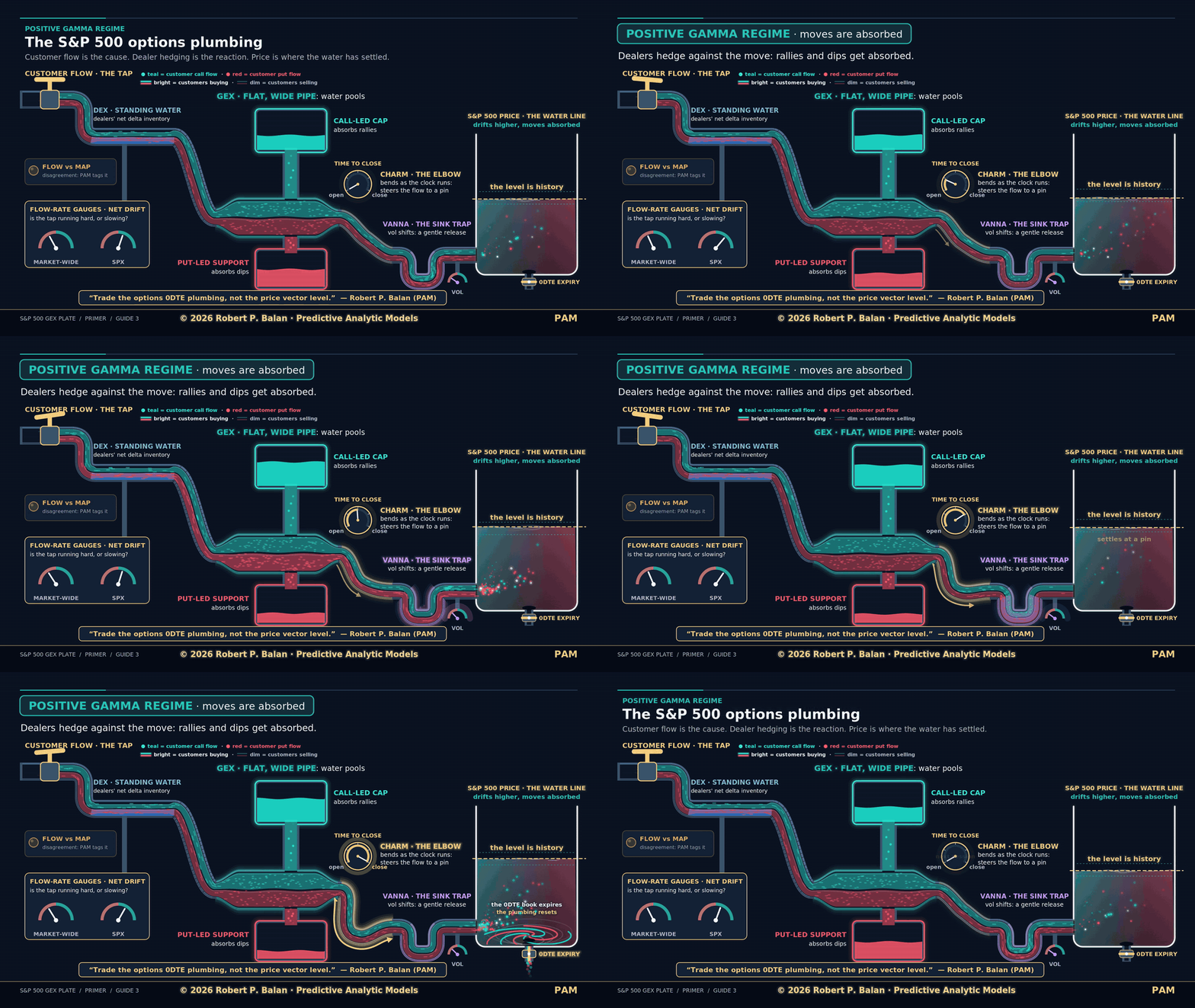
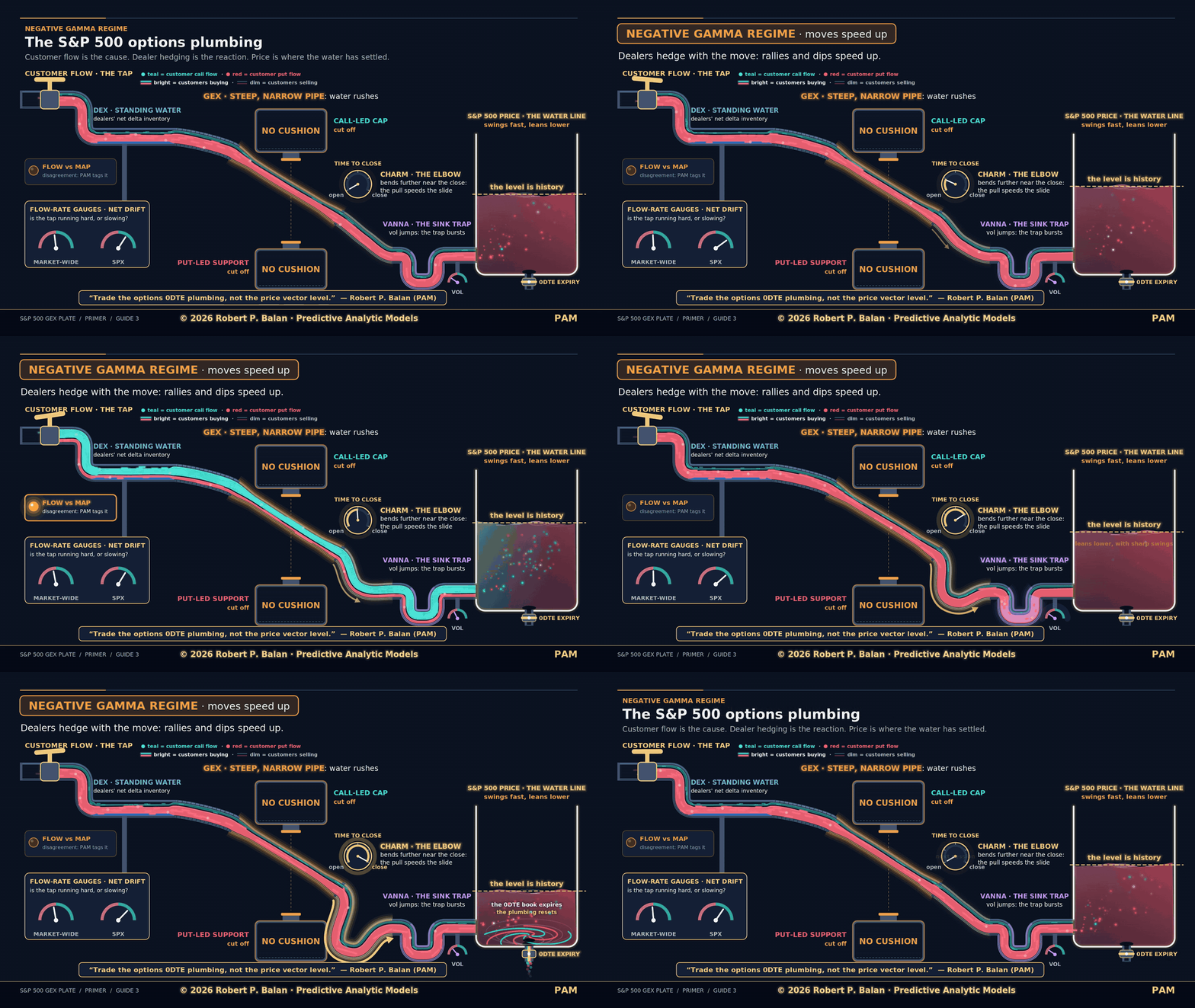
These are the quiet-reading versions. The voiced cuts above are the fuller telling.
"Trade the options 0DTE plumbing, not the price vector level." — Robert P. Balan (PAM)
Get the Game Plan and the 0DTE EOD Recap by email, free: Subscribe at Predictive Analytic Models
© 2026 Robert P. Balan · Predictive Analytic Models